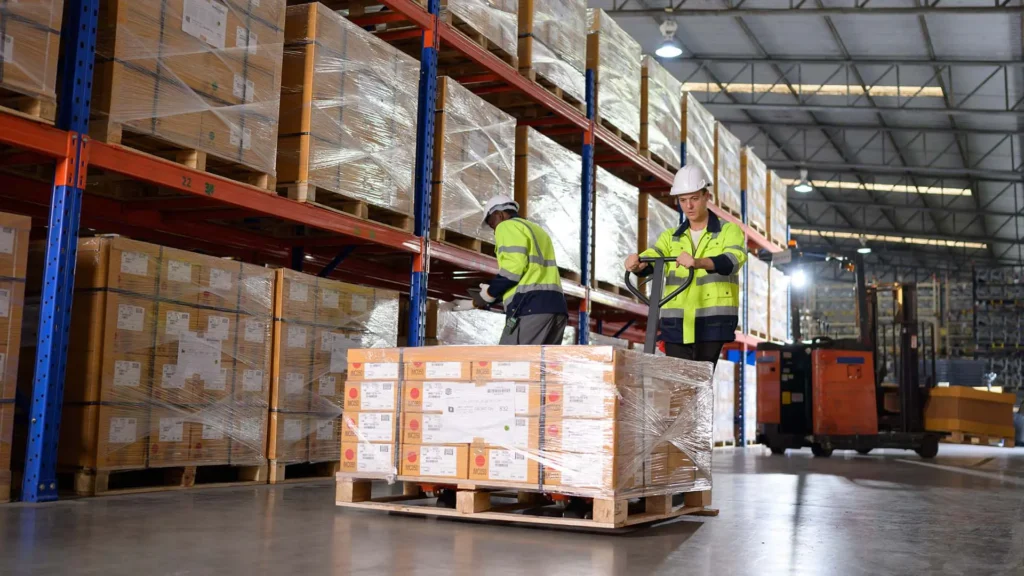
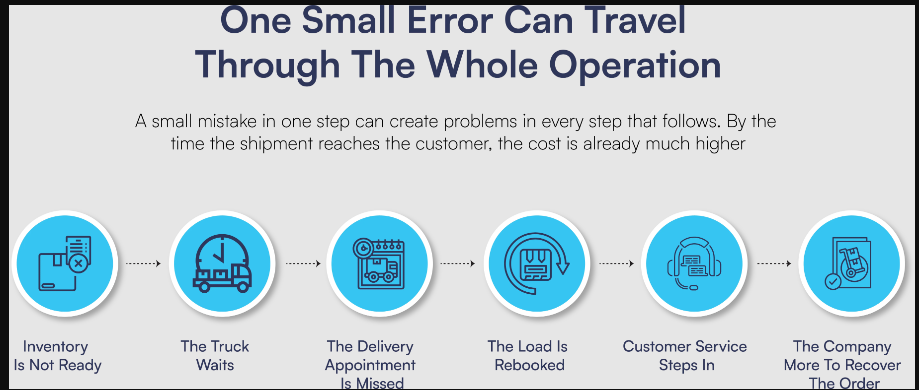
An order is marked ready, so transportation books a truck. The driver arrives and finds two pallets still sitting in receiving. By the time the freight is loaded, the delivery appointment is gone. The visible cost may be detention or a higher rebooking rate. The real cost goes further. The warehouse changes priorities. Customer service explains the delay. The customer starts questioning whether the next order will arrive on time. Distribution logistics losses can build through small mistakes repeated across hundreds or thousands of orders.
The detention charge may be what shows up on the freight bill, but it is rarely the full cost. When the same failure repeats across facilities, customers, or hundreds of shipments, companies can spend far more recovering from the problem than they would have spent fixing it.
The freight invoice rarely shows the full cost of a logistics failure.
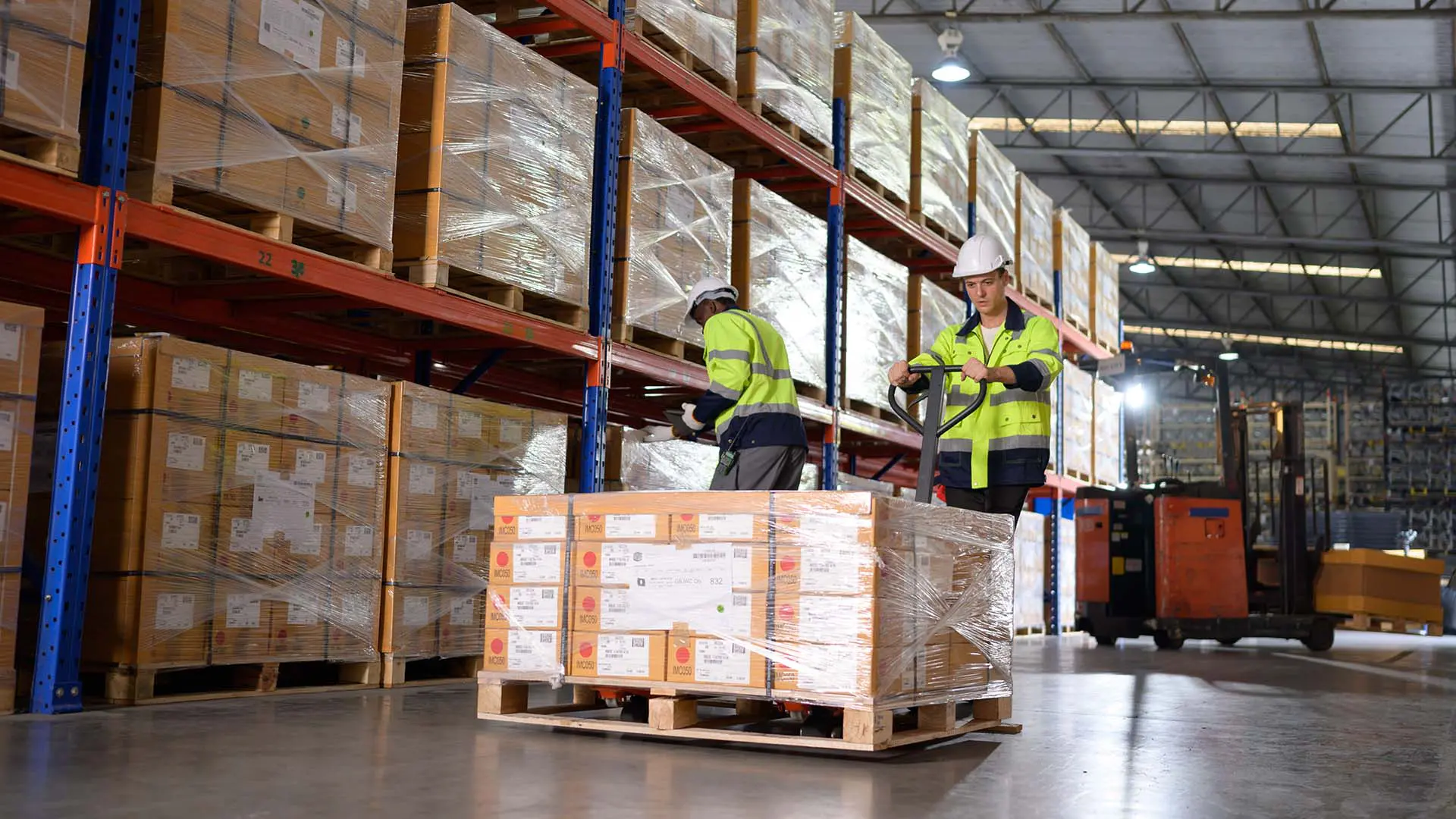
Consider a hypothetical example. If a company has 20 avoidable detention events each week at $250 per event, that alone represents about $260,000 a year. Add premium freight, redelivery, overtime, chargebacks, and other recovery costs, and the financial impact can grow quickly. Across multiple facilities or a national network, recurring leakage can add up quickly.
This is why the important question is not only what each logistics error costs on its own. Leaders also need to ask how often it happens, where it starts, and what the business keeps spending to recover from it.
A mistake becomes expensive when it is found late and pushed to the next team. The shipment may still be saved, but recovery usually costs more than prevention. For each error in this article, the pattern is the same. Something breaks upstream, it surfaces somewhere else, the company pays to recover, and a control that would have caught it earlier either did not exist or was not followed.
Poor Transportation Distribution Logistics Planning
In transportation distribution logistics, many companies plan around an expected ship date instead of confirmed readiness. A truck may already be scheduled while the order is still being picked. Sometimes the paperwork is not ready. In other cases, the load is waiting for inspection.
The mistake starts when transportation books a date instead of an executable move. It becomes visible when the driver arrives and the freight is not actually ready, or when a carrier is turned away and the appointment is lost. From there, the recovery cost stacks up fast: a rebooking fee, a detention charge, sometimes premium freight to make up the lost time. Using the hypothetical $250 detention amount above, even a handful of avoidable events each week can become meaningful recurring cost.
An earlier control is to align pickup commitments with a realistic, verified ready window. Capacity may need to be secured before an order is physically complete, but transportation should have a clear readiness check and a process for communicating changes before the carrier arrives.
I’ve found that the lowest rate means little when the move was never realistic. A low rate on a move that was never executable isn’t a savings. It can simply become a detention charge with extra steps.
Inefficient Warehousing and Distribution Logistics Processes
Warehouse delays are often blamed on staffing, but the process may be creating the problem. In warehousing and distribution logistics, freight can be handled several times before loading. A ready order may sit behind pallets scheduled for a later pickup. Drivers wait while employees clear space or search for paperwork.
The mistake starts in how freight is staged and sequenced, long before a driver ever shows up. It becomes visible as a truck sitting at the dock while a ready order can’t be located or reached. The recovery cost is not just that one wait time. It’s the labor spent on unnecessary touches, the dock capacity lost to a load that shouldn’t still be there, and the overtime added to a shift trying to catch up.
An earlier control is a staging process that reflects the facility’s layout, dock configuration, pickup schedule, order priorities, and operating requirements. The goal is to make ready freight accessible when it is needed, not to prescribe one sequencing method for every warehouse.
Adding labor does not automatically fix a process problem. Without addressing the underlying workflow, it can simply make an inefficient process more expensive to run.
Inventory Visibility Gaps Across Distribution Logistics Warehouses
A system may show 300 units, while the warehouse can only pick 190. The rest may be allocated, damaged, on hold, or waiting for putaway. In a distribution logistics warehouse, the system needs to show more than what is on hand. It should also show what is actually ready to pick and ship.
The mistake starts the moment inventory data stops reflecting physical reality. It becomes visible when transportation books capacity for freight that isn’t actually there, and the order has to split, expedite, or miss its date. The recovery cost includes the expedite itself, the labor spent correcting the error, and a working capital hit when inventory that looked available couldn’t actually support the order it was counted against.
An earlier control is ensuring transportation planning uses inventory information that reflects what is actually available and ready to ship—not simply what the system shows as on hand.
Bad inventory data doesn’t stay a warehouse problem. It becomes a transportation decision, a customer commitment, and eventually a number on a P&L that nobody traces back to its source.
Weak Distribution Logistics Management and Decision-Making
An order can pass through several hands and still have no clear owner from release through delivery. Strong distribution logistics management makes responsibility clear. One person confirms readiness. Another owns the exception. Someone updates the customer before the customer has to ask.
The mistake can start before anything goes wrong when ownership at each stage and responsibility for exceptions have never been clearly defined. It becomes visible only once something breaks and three teams are all waiting on each other to act. The recovery cost is the same shipment getting rescued week after week, at the price of premium freight, extra labor, or a customer credit, without the underlying cause ever getting fixed.
“Better communication” is too broad a fix for this. The right information has to reach the person who can still protect the order, and that person has to be named in advance, not figured out in the moment.
I’ve seen teams recover the same type of shipment over and over without ever touching the original cause. The order moves. The cost stays in the business. This is usually the point where it’s worth having someone look at ownership across the whole order lifecycle, not just the function where the failure happened to land.
Visibility tells you there is a problem. Ownership determines whether anything changes.
Last-Mile Delivery Delays That Hurt Customer Experience
A carrier can reach the correct address and still be refused. The purchase order number may be missing, or the receiving window may have closed. The truck may also arrive without equipment the facility requires for unloading.
The mistake starts well before dispatch, in whatever wasn’t confirmed about the receiving dock. It becomes visible as a failed delivery, the truck turned away after doing everything right up to that point. The recovery cost is redelivery, detention, an accessorial charge, and a customer who now has a reason to question the next order too.
The earlier control is a pre-dispatch check: appointment confirmed, site requirements confirmed, reference numbers and an escalation contact in hand before the truck leaves.
A failed delivery adds more than the redelivery cost. It weakens trust in a way that doesn’t show up on an invoice. If the same issue keeps happening, the business is paying repeatedly for something that should have been caught the day before, not the day of.
Planning Around Expected Conditions Instead of Actual Shipment Requirements
Some shipments have customer, product, equipment, appointment, security, or handling requirements that leave little room for improvisation. A plan can look workable on paper and still fail if those requirements are not confirmed before the move begins.
The mistake starts when you plan transportation around the expected case without confirming the constraints that could change execution. It becomes visible when a handoff, delay, equipment mismatch, or receiving issue leaves the team with fewer options than expected. Recovery can mean additional handling, rebooking, premium transportation, service failure, or product risk depending on the shipment.
An earlier control is to confirm the shipment’s specific requirements, critical handoffs, and escalation path before execution. The point is not to apply one process to every shipment. It is to make sure the operating plan matches the actual risk and requirements of the move.
Disconnected Systems and Manual Information Gaps
Disconnected systems can leave warehouse, inventory, and transportation teams working from different updates. Employees fill the gaps with spreadsheets, phone calls, and manual status changes. The problem is not always the age of the technology. It is whether the right information reaches the right person in time to act.
The mistake starts when systems don’t talk to each other, so no single update actually triggers the next decision. It becomes visible as a delay nobody caught in time, because the person who needed to know found out too late to do anything about it. The recovery cost is the manual work that fills the gap: extra labor, missed capacity, an expedite that wouldn’t have been needed if the information had arrived an hour earlier.
The earlier control isn’t necessarily new software. It’s making sure that once an order is complete, or once a delay appears, that information reaches someone who still has time to act on it, automatically rather than by someone remembering to make a call.
Automation does not replace ownership. It moves information faster. Poor data and unclear responsibility remain poor operations, even inside a newer system. I’d be cautious of any pitch that treats a new platform as the fix for a problem that’s really about who’s accountable for acting on what the platform shows.
How Distribution Controls Change by Operating Environment
The same logistics failure does not carry the same risk in every distribution environment. A delay manageable for one product can cause product loss or a service failure elsewhere.
Controls change with the product, but the principle does not: readiness, visibility, ownership, and handoff discipline must match the shipment’s risk.
Food Distribution Requires Speed and Accuracy
Food distribution is a useful example of how operating requirements can change the impact of the same logistics failure. Shelf life, receiving windows, dwell time, and product identification can make delays or information gaps more consequential than they would be for less time-sensitive freight.
For example, if a customer needs to locate a specific lot or understand where a shipment moved, the operation depends on accurate information being preserved across handoffs. When that visibility breaks down, teams can spend more time locating product, correcting orders, and managing customer issues.
The broader lesson extends beyond food distribution. Distribution controls should reflect the product, customer requirements, and consequences of a missed handoff.
When Pool Distribution Logistics Makes Sense
Pool distribution logistics can make sense when enough freight is moving into the same region to support consolidation. Instead of sending individual long-distance shipments to separate destinations, freight moves to a shared regional point before being sorted for local delivery.
That model can reduce linehaul costs and improve regional efficiency. But the savings depend on the operation working as planned. The additional handoff creates another point where freight can be delayed or misrouted.
Volume density matters because the model needs enough freight to justify consolidation. Sort accuracy matters because an error at the pool can affect several deliveries. Local scheduling matters because the savings from the linehaul can disappear if final-mile execution is poor.
The decision, then, is not simply whether pooling costs less. Leaders need to compare the linehaul savings against the added handling and coordination required to make the model work.
This is a coordination question more than a cost question. The linehaul savings are real on paper. Whether they survive contact with an extra handoff depends on whether someone is actually managing that handoff, not just assuming it will work.
Building a Smarter Distribution Logistics Strategy for Long-Term Growth
The better question is not how quickly a team can recover from a failed shipment. It is how early the cause can be removed.
That question changes how leaders look at recurring logistics problems. Instead of measuring how well the team handled the latest exception, they can look at why the exception keeps returning.
Distribution Control Checklist
- Confirm a realistic, verified ready window before committing pickup timing.
- Assign every exception to a named owner.
- Measure the total cost of exceptions, not just the freight invoice. Include detention, expedites, redelivery, overtime, and product loss.
- Review repeat failures by customer, facility, carrier, lane, and order type.
- Prepare backup capacity and escalation contacts before they are needed.
The warehouse, transportation team, inventory records, and customer requirements all need to line up. When one part falls behind, the extra work usually lands somewhere else. A transportation delay can create warehouse overtime. An inventory error can trigger premium freight. A missed delivery can create another customer-service issue.
Managing transportation, warehousing, and inventory visibility as connected functions, rather than as separate vendors reporting separately, gives leadership a broader view of where problems start and where recovery costs actually land. The value isn’t having more services under one provider for its own sake. It’s having enough visibility across managed transportation, warehousing and distribution, and the supply chain decisions behind them to catch a problem before the cost moves to another part of the business.
If the team spends most of the day calling, checking, and chasing updates, the process needs more than another quick fix. InstiCo helps companies find the gaps behind repeated delays, added freight costs, and weak handoffs, then builds a stronger plan around the full movement of the order.
Conclusion
Strong distribution logistics are usually built before the problem shows up. The order is checked properly, ownership stays clear, and the team looks back at what went wrong instead of simply moving on to the next shipment. Small errors will happen. The costly mistake is allowing the same issue to return across the next ten, hundred, or thousand orders.
One bad shipment does not mean the process is broken. But if your team keeps paying detention, expediting freight, rescheduling deliveries, chasing inventory, or explaining the same failures to customers, it is worth finding out why.
InstiCo helps companies look at where those problems begin, what they are really costing, and what needs to change so the team is not paying to solve the same problem again next week.
FAQs
How should a company calculate the true cost of a logistics error?
Include added freight, detention, overtime, extra handling, product loss, chargebacks, returns, customer service time, and lost sales. The carrier invoice rarely shows the full cost.
Which KPIs can reveal trouble before a customer complains?
Useful measures include pickup readiness, inventory accuracy, dock-to-load time, appointment compliance, exception age, detention hours, premium freight use, redelivery rate, and on-time-in-full performance.
When should a company consider outside distribution support?
Outside support may help when volume has outgrown manual coordination, the same failures keep returning, or no one owns the order from warehouse release through final delivery.