A delivery can run late even when the carrier did what it was asked to do. Production may not have released the order on time. The stock may be sitting at another location. Sales may have given the customer a date before checking with operations.
In our experience, a costly mistake is treating the point where a problem becomes visible as the point where it began. An expedited load may solve today’s service failure. It does not correct the purchasing, inventory, production, or transportation decision that created it.
Logistics and supply chain management often get grouped together. In practice, they handle different parts of the same order. Purchasing chooses the supplier. The inventory team decides how much stock to hold. Production sets the ready date. Sales tells the customer when to expect the order. All of that happens before transportation takes over.
The cost of that confusion rarely shows up where it started. A late purchasing decision becomes a freight expedite. A production delay becomes a customer service problem. The invoice lands on transportation, but the decision that caused it happened somewhere else entirely. That is the pattern worth understanding before assigning blame to the truck.
Logistics vs Supply Chain Management: What Sets Them Apart?
The clearest way to understand logistics vs supply chain is to separate the decisions from the execution. Supply chain management coordinates the network and decisions that determine how goods should flow. Logistics manages much of the physical flow within that network, including transportation, storage, handling, and fulfillment.
Follow one customer order and the difference becomes easier to see. Purchasing decides where the product comes from. Production works toward a ready date. Inventory planning determines what stock is available and where it should be. The warehouse prepares the order. Transportation moves it to the customer. Customer service steps in when something changes.
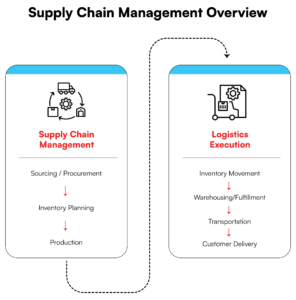
Logistics manages much of what happens to the product as it moves through that process. The wider supply chain connects those activities and the decisions behind them.
That distinction matters because a logistics problem is not always a logistics problem. A missed delivery could start with an unrealistic production date, insufficient inventory, a supplier issue, or a transportation decision made too late. The better question for leadership is not who missed the delivery. It is which decision, made earlier and somewhere else, actually created the risk.
Where Logistics Fits Within the Bigger Supply Chain
A lower supplier price can look like a good move. Then the longer lead time starts to matter. Purchasing has to buy more at once. The warehouse holds extra stock. Transportation has fewer options if demand changes. A small saving in one area can create more cost somewhere else.
I’ve learned to be skeptical of any savings that show up in a single line item. A lower supplier price that raises inventory, warehousing, or transportation cost has not actually saved the business anything. It has simply moved the cost somewhere less visible.
That is why the lowest individual cost is not always the lowest total cost. Leadership has to understand how purchasing decisions affect inventory carrying costs, warehouse capacity, transportation options, service levels, and ultimately the customer. We look at that as total landed cost or total network cost, not just the price paid to a supplier or carrier.
Good supply chain and logistics planning looks at the whole effect. The purchase price matters, but so do freight, storage, inventory, and customer service.
ASCM also places logistics within the wider supply chain. That fits what I see across most operations. Logistics teams handle freight, storage, and shipment updates. Decisions around suppliers, production, inventory, and customer commitments often happen earlier, made by people who never see the transportation bill those decisions eventually create.
Key Differences in Goals, Scope, and Daily Operations
The difference between logistics and supply chain management becomes clearer when you look at what each function is responsible for. The exact responsibilities vary by organization, but the distinction generally looks like this:
Logistics | Supply Chain Management | |
Primary focus | Execution and movement of goods | End-to-end network performance |
Key decisions | Carriers, routes, modes, storage, fulfillment | Sourcing, inventory, production, network, logistics |
Typical KPIs | Cost per load, on-time delivery, dwell, claims, transit time | Total cost, inventory, service levels, resilience, working capital |
Problem horizon | Daily shipment execution | Longer-term system and network decisions |
Typical problems | Missed pickups, delays, capacity issues, damaged freight | Stockouts, excess inventory, supplier issues, network costs |
The logistics team may be calling carriers, moving a pickup, checking the dock, or giving the customer an update. The problem may have started earlier. Purchasing placed the order late. Production changed the ready date. The stock showed in the system, but it was sitting in another building.
Logistics deals with the shipment that needs to move now. Supply chain management looks at the decisions that shaped that shipment in the first place. Fixing the immediate transportation issue rarely fixes the process behind it. The real question for leadership is whether anyone has visibility into that upstream decision at all, or whether it only becomes visible once it shows up as a late shipment.
This is where misdiagnosis happens most often. A shipment gets flagged as a carrier problem, a new carrier gets brought in, and the same issue resurfaces a few months later. In those cases, the carrier may not have been the root cause. It was simply the point where the problem became visible.
Real-World Examples That Make the Difference Easy to Understand
A manufacturer may bring one part in from overseas. Before it ships, the company has already picked the supplier, placed the order, and worked out how much stock it needs. Production is also waiting on that part.
From there, logistics takes over. Ocean freight, customs, drayage, storage, and the final run into the plant all come next. If the container is delayed, a 3PL or managed transportation partner can coordinate with carriers and other providers, improve visibility, and help identify available options for responding to the delay.
But if the company only has one supplier and no extra stock, the bigger problem starts before the shipment leaves. Changing the transportation plan may help with the current order. It will not solve the underlying supply risk. That calls for a broader supply-chain review.
Retail can run into the same kind of issue. The truck may arrive on time, but the store can still run out. The forecast may have been low, or the inventory may have gone to the wrong location.
In that situation, logistics can help investigate the movement and identify where the shipment went off track. If the recurring issue comes from forecasting, inventory allocation, or network design, the solution needs to look beyond transportation.
Good logistics and supply chain work depends on understanding which problem you actually have. Sometimes the answer is better transportation execution. Sometimes the freight is only where the problem becomes visible.
How Logistics and Supply Chain Management Work Together in Business
Most days, supply chain management and logistics come down to four things. Work out what is needed. Put the stock where it needs to be. Move the order. If the plan slips, deal with the shipment first and then look at what caused the problem.
An expedited shipment can save today’s customer order. It should not become the normal answer. If purchasing releases an order late or production changes its schedule, a lower freight rate will not fix the root issue.
According to the CSCMP’s 37th Annual State of Logistics Report, U.S. business logistics costs reached $2.4 trillion, or 7.8% of GDP. For an individual business, the important point is not the size of that national number. It is how small sources of leakage can repeat inside an operation.
Individually, these costs can be easy to explain away. That is exactly why recurring patterns can go unnoticed. A single expedite gets approved without much scrutiny. A pattern of them, repeated every month, rarely gets reviewed at all, because each one looks like a reasonable decision in isolation. The risk is not the individual cost. It is the absence of anyone whose job is to notice the pattern.
An unnecessary expedite may cost more than the original freight plan. Excess dwell can create accessorial charges and tie up equipment. Premium capacity can become routine when planning breaks down. Excess inventory can add storage and carrying costs. Redundant handling can add labor without adding value. Service failures can also create costs that never appear on a freight invoice.
Over the years, I’ve seen how seemingly small freight issues can become expensive patterns when no one steps back to examine the root cause. A late booking here, a poor route there, or a missed update may not look significant on its own. When the same issue happens every week, it stops being an operational hiccup and becomes a decision leadership needs to investigate.
That is where logistics and supply chain management need to work together. Transportation data can show where shipments are struggling. Broader supply-chain analysis can help determine why. The goal is not just to move today’s shipment. It is to find the recurring decisions and process gaps that keep creating the same problem.
Where 3PL and 4PL Services Fit
The difference between logistics and supply chain management also helps explain the difference between 3PL and 4PL services.
A 3PL typically helps execute specific parts of the logistics operation. That can include transportation, warehousing, freight coordination, or other defined services. The focus is usually on running the activities the business has chosen to outsource.
A 4PL or lead logistics partner takes a broader coordination role. Instead of managing one part of the operation, it can coordinate multiple logistics providers and help manage the wider transportation network.
The right model depends on the problem the business is trying to solve. If the need is better execution in a defined area, a 3PL may be the better fit. If the business needs broader coordination across providers and functions, a 4PL or lead logistics model may make more sense.
The key is matching the level of support to the actual problem, not the level of support that is easiest to sell. Better transportation execution cannot fix every supply-chain issue. But better coordination can make it easier to see where those issues begin, which is often the harder and more valuable thing to buy.
Logistics Management and Supply Chain: Which One Does Your Business Need?
The answer depends on where the problem begins. Logistics management and supply chain work overlap, but every issue does not require a full operational redesign.
Before changing the operation, leadership should identify where the recurring problem starts. A few questions can help narrow that down:
Diagnostic question | What it may indicate |
Are transportation costs rising even though the shipping profile has not materially changed? | A reason to review rates, carrier performance, accessorials, routing, and market conditions. |
Are different locations using different carriers, routing rules, or processes? | A lack of centralized management |
Are expedites compensating for inventory or production problems? | A broader supply chain issue |
Are you carrying excess inventory to protect against unreliable inbound transportation? | A transportation and inventory problem working together |
Can leadership see shipment, carrier, cost, and service performance in one place? | A visibility and data gap |
When to Focus on Logistics Management
A logistics review makes sense when the inventory and production plan are working, but transportation execution is not.
Common signs include:
- Inconsistent freight rates
- Poor carrier performance
- Missed pickups
- Weak shipment visibility
- Dock scheduling problems
- Frequent claims or delivery exceptions
- Fragmented carrier management
- Lack of centralized freight data
- High accessorial spend
- Excessive manual intervention
These problems often point to a need for more control over transportation rather than a complete supply chain redesign.
The connection between logistics and management becomes especially important when different locations book freight in different ways. Centralized carrier management can bring consistency across those locations. Shared freight data can give leadership a clearer view of cost and service. Defined routing and performance standards can also reduce the amount of daily intervention required.
Centralizing that kind of freight management is less about adding a layer of oversight and more about creating a single place where cost and service problems become visible before they repeat. For businesses without centralized transportation management, a managed transportation partner can provide that visibility across carriers, costs, service, and recurring exceptions. That is one of the roles InstiCo serves for its customers.
When End-to-End Supply Chain Management Makes More Sense
A wider supply chain/logistics review may be needed when the same problem keeps turning up across multiple functions.
Repeated expedites are a common sign. A different carrier may reduce one invoice, but it will not correct late purchasing, unreliable inventory records, or last-minute production changes. The freight bill shows the cost. The cause may sit several steps upstream.
That is where leadership needs to look beyond transportation. If inventory, purchasing, production, warehousing, and transportation are affecting one another, the solution may require a broader review of how the network operates.
The first step is not always changing the carrier. It is identifying where the problem actually begins.
Choosing Between Supply Chain Management vs Logistics Without Confusion
When deciding whether the problem is primarily logistics or part of the broader supply chain, start with where the recurring issue originates. If rates, carrier performance, routing, accessorials, or shipment visibility are the problem, a transportation-focused review may be enough. If the same failures are being created by inventory, purchasing, production, warehousing, or supplier decisions, the issue reaches beyond logistics.
The goal is not to broaden the solution unnecessarily. It is to match the response to the source of the problem.
Conclusion
The question is not whether a problem is ‘logistics’ or ‘supply chain’ for the sake of terminology. The question is where the problem starts, what it costs when it repeats, and who has the visibility and accountability to correct it.
A missed pickup may be a carrier issue. Repeated expedites, accessorials, inventory problems, or service failures may point further upstream. Before changing carriers or redesigning the operation, leadership needs to identify the decision or process that keeps creating the failure.
InstiCo helps businesses review recurring logistics and supply-chain problems to identify where they begin, what they cost, and what needs to change so the same issue doesn’t keep returning.
FAQs
Is logistics part of supply chain management?
Yes. Logistics handles transportation, storage, fulfillment, and delivery. Supply chain management also covers sourcing, production, inventory planning, and customer demand.
Can better logistics solve a broader supply chain problem?
Not by itself. A strong carrier and warehouse operation cannot fully correct poor forecasts, supplier delays, or inventory held in the wrong location.
What is a simple example of logistics versus supply chain management?
Choosing a supplier and deciding how much inventory to hold are supply chain decisions. Receiving, storing, moving, and delivering that inventory are logistics activities.